Who to Involve When Buying an Elearning Content Library
You’ve been given the task of buying a new elearning content library for your organisation. It might be the first time you’ve done it. You may have walked around Learning Technologies, World of Learning, or ATD, seen something that caught your attention, and now you’re working out how to get it over the line. What most people don’t realise at this stage is that you’re going to need more people involved than you think.
If you are comparing elearning content library providers, the people you involve early can shape the quality of the decision, the pricing conversation, and the contract you eventually sign.
I’ve run Real Projects for years. We’ve built and maintained an elearning content library of over 800 courses. I know what people buy and why. I’ve stood on our stand at exhibitions and had people come up to me who are comparing providers, reviewing their options, or approaching the end of a contract and not sure where to start. I’ve had this conversation more times than I can count.

Learning Technologies, ExCeL London.
It doesn’t matter whether you’re buying a library for the first time, replacing an existing provider that isn’t working, or approaching the end of a contract that came bundled with your LMS. Getting this decision right means involving the right people, at the right time, in the right way.
This article sets out who those people are and how to work with them effectively.
There are two groups of people to think about
When you’re buying an elearning content library, there are two distinct groups you need to engage. The first is your end users, the people who’ll actually use the content. The second is your key stakeholders, the people you need to get the decision over the line.
Both groups matter. Both need to be brought in earlier than most people expect. Confusing the two, or neglecting either one, is where buying decisions start to go wrong.
Before you shortlist vendors or request course examples, it’s worth being honest about whether you’ve actually spoken to your users. Do you know what they need? Do you know what they’re not getting from what you have now?
Start with your users
Before you look at a single demo or shortlist a single provider, talk to the people who’ll use the content. If your organisation already has an elearning library, these are the people using it now. What do they think of it? Is it working? Where are the gaps?
These conversations give you something no sales demo can. A clear picture of what you actually need to buy. When you are comparing elearning content library providers, your users will help you see past the demo and focus on whether the content will actually work inside your organisation.
The organisations that get this right are the ones who went in knowing what their users needed rather than what looked good on a stand. Your users will tell you what’s missing, what they won’t engage with, and what to look for in an elearning course library from the perspective of the people who matter most.
They’re also the people you want involved when you’re evaluating your shortlist. Get them looking at demo content. Ask for their reactions. If the people using the library every day don’t rate it, the investment won’t deliver what you need.
I read the posts about ROI and impact. If you buy a library that no one is using, you’ll get neither.
Think of your stakeholders like a pyramid
A lot of people will want to get involved when a project like this gets started. The reality is that only a small number of them will make the final decision. Think of it as a pyramid. Get everyone into the conversation early, but be clear about who’s at the top and who’s there to inform rather than decide.
The risk of involving too many people as decision-makers is that you never actually make a decision. Your job is to facilitate the process, gather the right information from the right people, and bring it together clearly for whoever has the final say.
Individual conversations are often more useful than large group meetings. You don’t need finance, IT, legal, L&D, and your platform manager in the same room at the same time. Go to each of them separately, get what you need, and then consolidate.
“Get everybody involved at the start and only move through the layers. It’s the people at the top who make the decision, but you need to get all those people into the conversation early to make sure you’re making the right one.”
Scott Hewitt, Founder, Real Projects
Finance: involve them earlier than you think
This is the mistake I see most often. Finance are treated as the people who raise the purchase order and pay for it. That’s a waste of what they can offer.
When you are reviewing pricing or building a business case for a new content library, finance are the people who make that work. They’ll help you understand the commercial model, the licence terms, the multi-year costs, and the total cost of ownership. They’re good at building financial models, and they’ll help you make sense of the numbers in a way that carries real weight with decision-makers.
It’s not just about return on investment (ROI), either. Finance can help you look at usage data and analytics, model out scenarios, and stress-test the numbers before you commit. If you’re working with data in spreadsheets or putting it through AI tools, get your finance team involved. They’ll help you build something credible. Understanding elearning library pricing properly is much easier when finance are helping you read the numbers.
Bring them in when you start looking at the commercial model, not when you’ve already chosen a provider.
IT: before you demo anything
The content you buy has to work in your LMS or Learning Experience Platform (LXP). That sounds obvious, but IT are often brought in after a decision has already been made, which creates real problems.
If you already have an LMS, the real question is often whether the content you’re considering will actually work inside it. Get IT involved before you fall in love with a library. They need to check SCORM compatibility, file formats, metadata, upload processes, and application programming interface (API) requirements. They’ll also want to understand your mobile requirements, your infrastructure situation, your AI stack, and your wider technology roadmap.
The best approach is to get your tech people talking directly to the vendor’s tech people. It removes assumptions and surfaces issues early. What your IT team discovers in those conversations will shape which providers make your shortlist.
Don’t leave this conversation until implementation. By then, it’s too late to change course without cost and delay.
“Get your tech people speaking to their tech people. That makes things a lot easier. You’re talking about capabilities, what you’ve got, what you need, and what’s coming. Those conversations need to happen before you commit.”
Scott Hewitt, Founder, Real Projects
Legal: when you’re down to your shortlist
You don’t need legal involved at the very start, when you’ve got a long list of potential providers and you’re still in the research phase. But when you’re down to two or three options and you’re ready to review licensing options, get them reading the contracts.
At Real Projects we’ve helped customers who had come out of contracts where the renewal price had become too expensive and the terms hadn’t changed. I’ve helped a customer whose library hadn’t been updated in years. I’ve advised a company to watch for auto-renewal clauses where the contract ticks over and you can’t get out of it for another three years. Before you commit to a supplier, make sure legal has reviewed the renewal terms. It’s the detail that catches people out.
Elearning library contracts are more complex than most people expect. There are licence terms, renewal clauses, price escalation provisions, termination rights, and copyright considerations. These are the things that catch organisations out, often a year or two in when it’s too late to do much about it.
Legal are there to protect you. They’ll check what you’re actually signing up to, flag anything that needs renegotiating, and make sure the contract reflects what you were promised. Don’t send them in blind. Brief them on what you’re buying, what the commercial model is, and what your key concerns are before they read the contract.
The person who runs your platform
This is probably the most overlooked person in the whole process. Your LMS administrator or platform manager is the person who’ll upload, organise, and maintain the content day to day once you’ve signed. Their practical input matters, and it matters early.
They’ll look at things that nobody else in the process will think to check. Whether the metadata is any good, whether it maps cleanly to what you’ve already got in your platform, whether the file structure is going to cause problems at scale. These are the things that make a library easy or painful to manage in practice.
Get them involved in the evaluation. Let them look at a sample upload. Ask for their view on the technical quality of the content files. If they spot issues before you sign, you can address them. If they spot issues after, you’re stuck with them.
“The LMS administrator is often the most overlooked person in the buying process. They’re the ones who’ll deal with the content every day. If they spot problems before you sign, you can fix them. If they spot them after, you can’t.”
Scott Hewitt, Founder, Real Projects
Who doesn’t need to be in every meeting
Getting the right people involved doesn’t mean getting everyone together at the same time for every conversation. That’s one of the fastest ways to slow a decision down.
Finance, IT, legal, L&D, and your platform manager each have a specific role to play. They don’t all need to be in the same room. Your job is to have the right conversation with each of them, gather what you need, and bring it together into a clear recommendation for whoever is making the final decision.
Be deliberate about who comes to which meeting. Too many voices in every conversation creates noise, slows things down, and blurs accountability. Keep it focused.
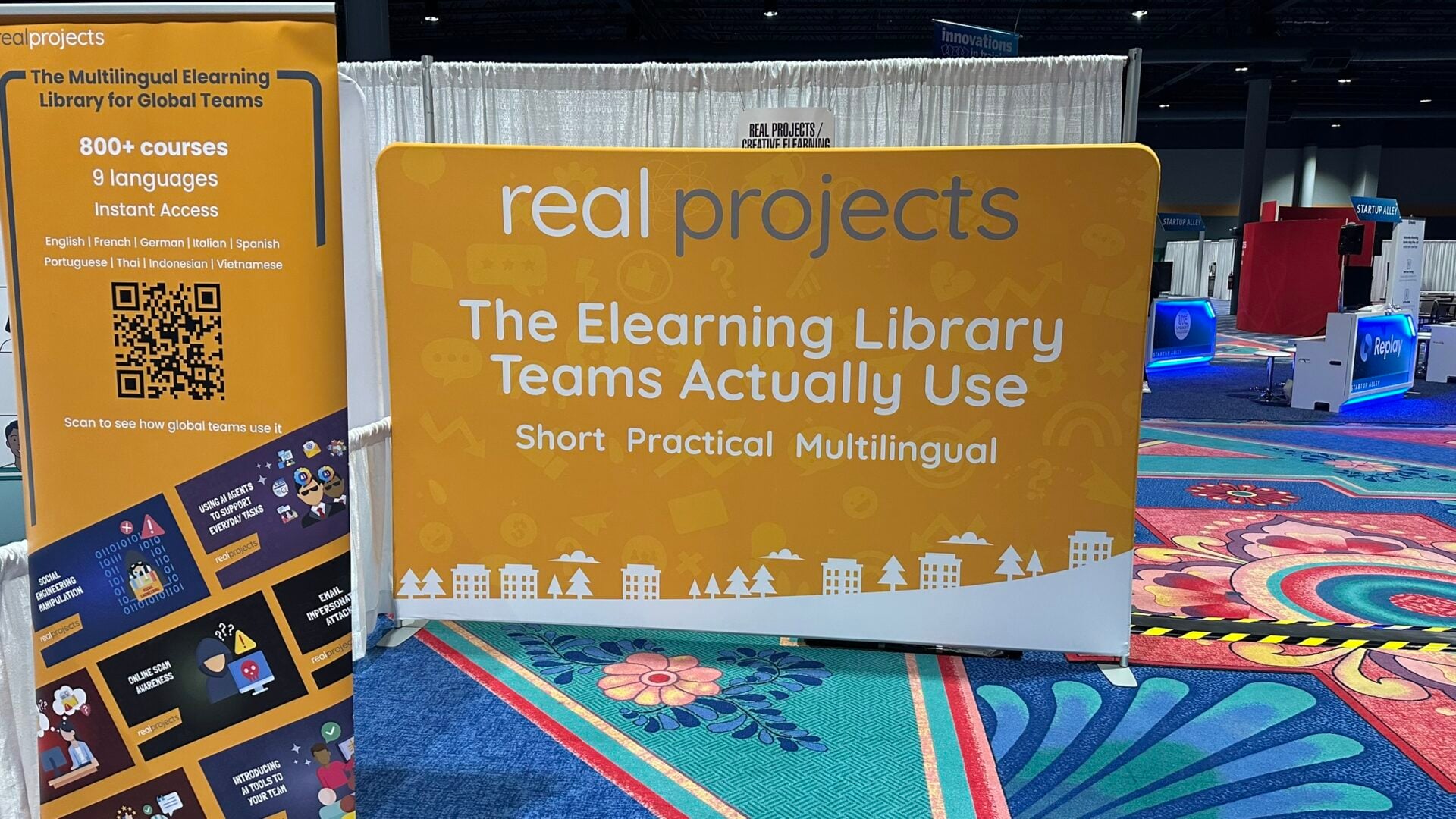
Real Projects at Training Magazine Network, Orlando.
A note on timing
The earlier you involve the right people, the smoother the process will be. But timing matters. Not everyone needs to come in at the same stage.
Finance and IT can come in early, while you’re still exploring the market and building your requirements. Your users should be involved from the start. Legal comes in when you’re close to a decision and working through the detail of specific contracts.
Bringing anyone in at the contract stage for the first time creates problems. They’ll slow things down, raise questions that should have been answered earlier, and potentially unwind progress you’ve already made.
If you’re approaching the end of an existing contract, the timeline feels shorter than it is. Buying an elearning content library takes longer than most people expect. Build in enough time for each of these conversations to happen properly. The complete guide to buying an elearning course library is a good place to start if you’re still working out where to begin.
Questions to ask before your first stakeholder meeting
Before you start involving other people, it helps to be clear on a few things yourself. These are the questions worth answering first.
What do you actually have at the moment, and is it being used? What’s the gap between what you have and what you need? What’s your timeline, and is it realistic? Who has the final decision-making authority in your organisation for a purchase like this? And what does success look like, not for procurement, but for the learners using the content?
If you are at the point of shortlisting providers, this is where the process becomes more practical. You need course examples, pricing, licence terms, technical checks, and a clear view of who needs to sign off the decision. You can turn this into a simple checklist and share it with your team.
The clearer you are on those before you start, the better the conversations you’ll have with everyone else. If you’re not sure where to begin, that’s exactly the conversation we have with organisations at Real Projects. Tell us where you are and we’ll help you work out what you need, whether that’s sample courses, a content recommendation, or a straight conversation about pricing.
“If you don’t know what you’re looking for, you’re probably not ready to buy yet. Define what you need first. Then go out and find it.”
Scott Hewitt, Founder, Real Projects
Frequently asked questions
Who makes the final decision on buying an elearning content library?
In most organisations, the final decision sits with a senior L&D, HR, or operations leader, often with sign-off from finance. The buying process typically involves a wider group of stakeholders who inform and influence that decision, including IT, legal, and end users, but the final call usually rests with one or two people at the top of the approval chain.
Do you need IT involved if you already have an LMS?
Yes. Having an LMS in place doesn’t remove the need for IT involvement. New content still needs to be technically compatible with your platform, and your IT team will need to check file formats, SCORM compatibility, metadata standards, and upload processes. If you’re replacing an existing provider, they’ll also need to manage the transition on the platform side.
When should legal get involved in buying an elearning library?
Legal should come in when you’re down to a shortlist of two or three providers and ready to review licensing options in detail. They don’t need to be involved in early research or vendor conversations, but they should review any contract before it’s signed. Licence terms, renewal clauses, price escalation, and termination rights are the areas that most often cause problems if they’re not checked properly.
Can one person manage the whole buying process?
One person can lead and coordinate the process, but it’s rarely a good idea for one person to make all the decisions alone. The buying process benefits from input across finance, IT, legal, and end users. The role of the person leading it is to facilitate those conversations, gather the right information, and bring a clear recommendation to the final decision-maker.
How long does it take to buy an elearning content library?
Longer than most people expect. A thorough process, including user research, stakeholder engagement, vendor evaluation, content review, and contract negotiation, typically takes three to six months. Organisations that try to compress this timeline often end up making rushed decisions that cost more to fix later. If you’re approaching a contract renewal, start earlier than feels necessary.
Scott Hewitt
Scott Hewitt is the founder of Real Projects, an off-the-shelf elearning content library trusted by organisations including HowNow, OpenSesame, Ticketmaster, and easyJet. He has built a library of over 800 courses across nine languages, with a focus on practical workplace training that’s ready to deploy on any major LMS.
Scott regularly meets L&D leaders at events including Learning Technologies and World of Learning. The buying conversations he has at those events, and the mistakes he sees organisations make, are what shaped this article.
 Connect on LinkedIn