Off-the-shelf elearning content presents a variety of advantages for those working within Learning and Development departments. But I want to go beyond the obvious. The speed of deployment, the cost, the range , you’ve probably seen all of that before. I’ve spoken to people about how to get content out for years. I started with the RM Window Box, working in educational elearning and getting what had been on CD-Rom onto a server so content could be accessed more easily. The market has come a long way since then, and the advantages have grown with it.
The No-Content Strategy Doesn’t Work
I’m reading a lot of posts about how organisations don’t need content. It’s all about impact. About behavioural change. About how people are overloaded with content and you need to go with a no-content strategy. I don’t think this works. Why? Because there are content areas and sectors that need to be updated constantly, and you need to be aware of what’s happening all the time.
That’s one of the real advantages of buying off the shelf. Do you really want a team that is constantly trying to keep up to date with all the information across every topic you cover? I read recently about a cyber security expert who had been the subject of a sophisticated phishing and social engineering campaign. His point was clear: it can happen to any of us, but we need to make sure our teams and employees are aware of everything that’s happening.
A great off-the-shelf library will be providing the latest content, updates, and courses to keep you informed. That is a key advantage for you and your team. A no-content strategy simply doesn’t provide this. And do you want to know the impact of that? A major risk to your cyber security protocols.
The potential of off-the-shelf content remains misunderstood and underestimated. There are now multiple specialist providers offering high quality content. There is still some poor quality content out there, and I still see it most weeks. But the advantage of the market growing is that it is easier to identify quality, and you have the opportunity to buy from a much larger pool of suppliers. You don’t need to stick with your LMS provider’s bundled library. You can buy quality content independently.
Time and Cost Savings
Businesses are rarely granted the ability to take on a project with unlimited budget and time. Off-the-shelf elearning fulfils the need for a quick, affordable, and scalable training solution.
Everyone talks about time, and it is mainly about deployment: how quickly can you get content out? That is where the obvious saving sits. But there are more time savings to consider. Many people compare off-the-shelf to custom content, but this is rarely a fair comparison. You are probably talking about a small number of custom courses versus a whole library, so the comparison is not really what you think.
Here is a question worth asking: do you actually run internal timesheets? Do you know what your team costs? If you know this, and you get the right platform and the right content, you can start to understand the real savings. How much time do you save getting the right content out to the right people? How much time have you saved by responding to a training query quickly because the content was already there? This is a saving that is consistently overlooked. The conversation tends to focus on custom vs bespoke costs, or on LMS reporting, but the internal team saving is just as real.
There are content areas that require custom development and specific solutions. These projects can involve longer development timelines and increased budgets, with multiple rounds of reviews, quality control checks, and potentially awarding body submissions. Off-the-shelf bypasses all of that. Courses are available immediately and can be deployed within hours. In most cases a per-course or licence fee is payable. Low running costs make off-the-shelf an affordable option, and the cost per person at scale is usually very favourable compared to custom development.
Do You Know Your Total Cost of Ownership?
The LMS end has some key savings to consider, but how many people actually look at the reports properly? Let’s not get stuck on compliance completion rates, in my view this is a statistic that is often overlooked and then criticised because it hasn’t been used well. At a very simple level, let’s look at whether courses are being used at all. Does this match your original usage plan?
We are not looking at impact or behaviour change at this stage. We are looking at a very simple ROI or total cost of ownership question. If the courses are not being used and time in the platform is low, are you getting the cost savings you were looking for? People don’t openly want to talk about costs, but we know they matter. You need to look after the overhead. Unfortunately too many people do not fully understand the cost basis they are working with.
Custom elearning content requires a specific development team: developers, L&D specialists, designers, animators, and more depending on the requirement. If you do not have these skills in house you will need to go through a procurement process to find them. Off-the-shelf removes that overhead entirely. The financial costs are demonstrably lower when deploying content to large audiences, and the time to market is significantly shorter.
Quality Is Not a Compromise
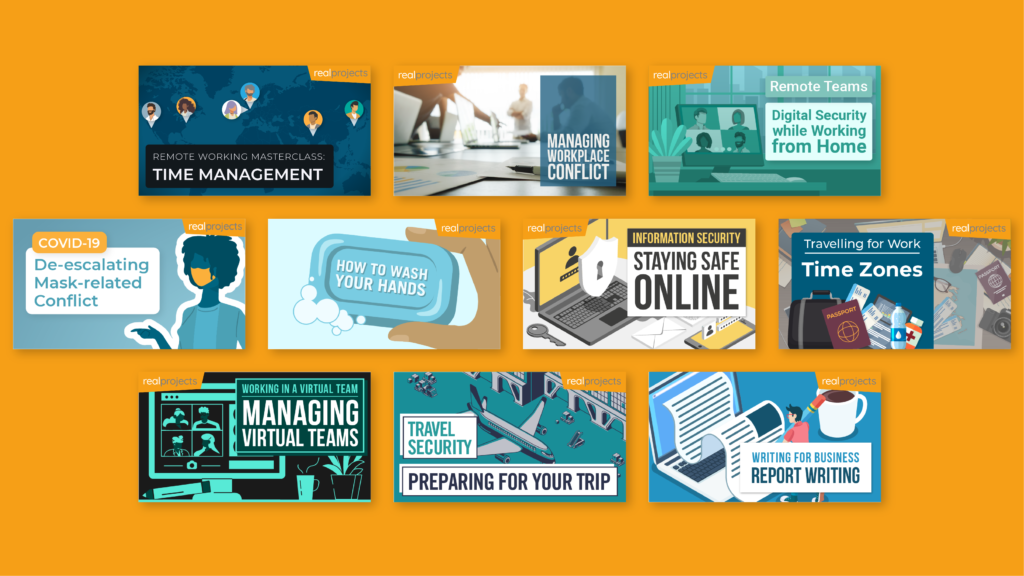
There remains a misconception that off-the-shelf content is not of high quality. The reality is that an established industry is now providing high quality, award-winning, and specialist content. Off-the-shelf content is frequently produced by the same subject matter experts and development teams that also produce custom elearning solutions.
At Real Projects, our off-the-shelf team is the same team that works on custom content. The instructional design, development, and quality assurance processes are the same. The difference is that the cost of that expertise is spread across many customers rather than borne by one organisation.
Reputable providers work with subject matter experts to develop courses that are accurate, broad in coverage, and genuinely engaging. The quality bar has risen significantly, and the consistency that off-the-shelf elearning provides is something that is easy to undervalue until you are trying to maintain it yourself across multiple topics and regions.
You Become the Curators
The opportunity to become a curator is often overlooked. One of the criticisms put forward about off-the-shelf is that people don’t use the content, that usage is low, that people forget what’s there. But you can’t just put content in and expect people to go and find it from a long list of titles.
Look at how video streaming platforms like Netflix and Disney work. They actively promote their titles on other platforms using trailers. They are also very good at providing categories, liked items, and recommendations, the equivalent of a learning path. This is something you can do too. You need to understand what is in the library you’ve bought, and you can start building learning paths around it.
Think about when you walk into a library or bookshop and there are recommended titles on display. You can be doing the same thing: recommending courses, building playlists, and sending these out via email or internal messages to people across the organisation. You need to be the curator of the content.

Understand the Data
This is where L&D starts to become commercially viable and begins to contribute something more than course data to the rest of the business. The content library can help you understand whether the investment was actually worth it, but also where you need to spend in the future and what the gaps are. If your LMS or LXP supports it, you are also getting data at an extra level and starting to understand what your teams are actually looking for.
If you think about SEO, you can start to apply the same thinking to your content library: what are people searching for, and what does that tell you about intent? If a topic gets little engagement, it may not need a bespoke programme. But if you are getting repeated searches around the same terms, it might be time to build something more substantial, something that goes beyond off the shelf and is supported by a custom programme or in-the-field training.
A short off-the-shelf course on giving feedback might be enough for general awareness. But if feedback content is used heavily across several departments, and managers keep asking for support, that might justify a custom workshop, a manager toolkit, or an internal campaign. Off-the-shelf content can act as a testing ground. It lets L&D see what people need before committing to a larger project. That is a much smarter use of budget than guessing.
The distraction with data can be that people obsess about the conception of vanity metrics and dismiss data they think has no value. But what matters is what you do with it and how it connects to your organisation. Looking through the usage data you can also identify specific challenges within the organisation and use internal marketing to boost a programme, and with off-the-shelf, you already have the content in place.
When people can search, browse, and choose from a wider range of topics, their behaviour starts to tell a story. Which courses are they opening? Which topics are they searching for? Where are completions highest? Which subjects are people returning to? Which areas are being used by specific teams, roles, or locations? This gives L&D a different view of learning needs, not just the needs that appear in stakeholder requests or annual planning meetings, but the needs people reveal through action.
If communication, leadership, or wellbeing courses are being used heavily, it may point to a wider organisational need. If people are repeatedly searching for time management or managing pressure, that may suggest workload issues in a particular area, something you could flag to managers who may not have been aware. The data goes beyond training needs. You can find insights into process and workflow challenges, and improvements, within your organisation.
Learning Camouflage
There are times when people don’t want to admit they need help, or what they need help with. I’ve been writing letters for years, and I still occasionally search a quick layout guide. People simply don’t always want to put their hand up.
This is especially true with topics like business writing, communication, conflict management, stress, wellbeing, or time management. People are unlikely to reach out and say “I’m struggling with my manager” or “I don’t know how to have a difficult conversation.” The off-the-shelf library becomes a useful, low-pressure way to discover sensitive needs without it becoming a big deal. This is a significant advantage: not cost, not speed, but psychological safety.
What you do need to think about is how you support this and how you handle the reporting. Do people really want to engage with wellbeing content and then receive a follow-up message saying “I saw you were looking at stress management, let’s book a time”? You need to think carefully about how you deal with reporting for sensitive content and what additional support you provide alongside it.

The Range Available Today
A browse online uncovers off-the-shelf elearning covering just about every topic you would expect, and many you might not. Content choice has grown rapidly. There remains strong coverage of compliance, soft skills, and general workplace training, but sector-specific content including energy, medical, legal, sport, and more has all seen dedicated platforms emerge.
Companies that subscribe to an off-the-shelf library will also get access to a roadmap, outlining upcoming releases during the year. Many providers actively consult customers on what they would like to see developed next. This gives L&D teams the ability to extend their content offer well beyond what they could build with internal resources alone.
Content as Part of Your Learning Strategy
Custom development will often be part of the learning mix. Off-the-shelf elearning and bespoke content are not an either/or decision. An off-the-shelf library works best as part of a broader strategy, providing the foundation and the coverage while custom content addresses the specific requirements that nothing pre-built can meet.
It is true that many organisations shied away from off-the-shelf content in favour of a more bespoke approach. Today, with the variety and quality of content available, the benefits are clearer than they have ever been. The question is not whether to use it, but how to use it well.
The wider appeal of elearning also provides opportunities for neurodivergent learners and those who are geographically remote, where training may not otherwise be readily available. Off-the-shelf content delivered through a well-configured LMS or LXP makes that reach possible at a scale that in-house development simply cannot match.
Frequently Asked Questions
What are the main advantages of buying off-the-shelf elearning?
Speed of deployment, lower cost per learner at scale, no need for an internal development team, and access to expert-produced content that is regularly updated. The total cost of ownership is usually significantly lower than building equivalent content in house.
Is off-the-shelf elearning good quality?
Quality varies, but the best providers use the same instructional designers and subject matter experts for off-the-shelf content as they do for custom development. The difference is that the cost of that expertise is spread across many customers. Review demos carefully and use a scoring matrix before committing.
How do you calculate the ROI of off-the-shelf elearning?
Start with total cost of ownership: licence fees, platform costs, and internal time spent on administration and rollout. Compare this against the cost of building equivalent content in house, including developer time, SME time, QA rounds, and ongoing maintenance. Then look at usage data: are the courses being used? Does that match your original plan?
Can off-the-shelf elearning replace bespoke content?
Not entirely, and it is not designed to. Off-the-shelf works best for common topics where the core knowledge is broadly consistent across organisations: compliance, cyber security, leadership, soft skills. Bespoke content is needed for highly specific processes, culture, or requirements that nothing pre-built can address. Most effective L&D strategies use both.
Scott Hewitt
Scott Hewitt is the founder of Real Projects, an off-the-shelf elearning content library trusted by organisations including HowNow, OpenSesame, Ticketmaster, and easyJet. He has built a library of over 800 courses across nine languages, with a focus on practical workplace training that’s ready to deploy on any major LMS.
Scott has spent over 25 years working in elearning as a buyer, supplier, and creator, advising organisations on how to build cost-effective learning strategies using the right mix of off-the-shelf and bespoke content.
 Connect on LinkedIn